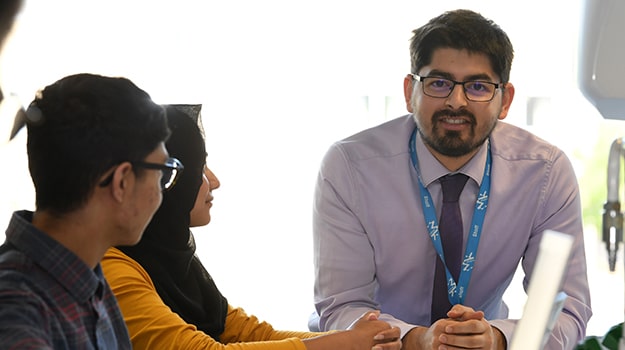
Mark Beharry spent six years in the police force, much of it spent in forensics and gaining a forensic science degree at the University of Lincoln. He joined Milton Keynes College in 2017 as a general science teacher and is now course team leader for forensic and applied science programmes.
I left school to study public services at Milton Keynes College and after two years joined the police as a special constable. I began to realise that as a teacher I could make a significant difference to people wanting to join the service as few new police recruits had any idea what forensic science was. So I went into teaching forensics full-time and returned to my old college as a basic science teacher.
I teach students aged 16-19 about dealing with real crime, its effects and how to investigate it. We build a crime scene so students get proper experience of real investigating. We have a 2:1 female:male ratio and none of the students are squeamish when it comes to dissections! We are breaking new boundaries in how we teach forensics, dealing with real crime, its effects and how to investigate it. We build simulated crime scenes so students get proper, real experience of investigation - many other colleges don’t do that. All the lecturers I have personally brought in are either ex-police officers or other experts who have worked in forensics.
Since last September I stepped up to run the college’s entire science programme to include its applied sciences level 2 programme as well. I now manage four different labs and staff besides teaching level 2 applied science and level 3 forensics.
It’s the opportunity to give people choice in their education and career, letting them picking what they want to do and specialising in it. I have more than 100 students and few know what they want to do do - but FE lets them experience what forensic science is all about.
I tend to work from 8am to 8pm four days a week. A normal day comprises four lessons lasting 90 minutes each. I do three full days of teaching plus a day of admin if not covering for colleagues plus a couple of hours spent on internal meetings. There is also lots of marking on top of that!
In a recent typical level 2 applied science programme session, we looked at space and energy in the universe. I introduced the actual topic and aims of the day and asked what did they know about space. How many planets are in the universe? What is the universe? How would you monitor space or the solar system?
Forensic science is taught at level 3 and my third lesson of the day was looking at criminal investigation and criminology. We went through theories and then related them to crime. Why did people commit crime? We looked at the psychological theories behind it, social policy, law-making, data analysis and statistics, moving on to punishment for crime - imprisonment through to capital punishment.
They love a good story! I’ll take the subject we are learning about and then apply one of my own relevant, real-life stories to that subject and get them figure out their own story and where this would apply in the actual subject itself.
They also love practical work, going out to a specially built crime scene. They will be physically digging up mock simulated graves full of fake bones, then record the whole process. In reality it takes about a week but they will do it in three hours. It enables them to develop their photography and crime scene investigation skills. We send our students up to the morgue to experience dealing with bodies and death. They like it and the morgue manager has asked us to stop sending so many students as they have don’t have enough bodies!
Assessments - there are so many to carry out. The BTec courses see students go through one practical assessment and then move into another that is from a completely different course unit. It’s about keeping on top of this element and ensuring students don’t get overwhelmed.
I’m proud of my year 2 group. When they first came to college they all had great expectations about what they wanted to do and now they are leaving much wiser and more capable and able to forge ahead in their careers. One is taking the apprenticeship route; the other 31 have university offers. Also, when I arrived in 2017 only eight students were on forensic science programmes; now it’s 103.
Time management and organisation for 90% of the day. The job will throw you lot of curve balls so you need to think on your feet. If you are a staff member down, you have to be creative. You also have to be open-minded. Ask yourself how will you investigate a crime such as rape or child abuse without getting emotionally involved. We talk very openly and in specific detail about what they need to know. We tell them how it is.
You need a science degree and level 4 or 5 teacher training qualification before teaching full-time. Several people I work with in forensics have a masters or higher degreee.
Why do you want to teach and what are your weaknesses? If people let me know their weaknesses, I can build on that.
I really want to help people learn about science and forensic investigation. If I was not here to deliver science programmes, my students would miss out.
Do you have a passion for Science? Is teaching or lecturing a career path that you have been considering? If so, take a look at our live vacancies in the sciences field as a teacher or lecturer and apply to kickstart your new career!
AoCJobs, part of the Association of Colleges, connects teachers and support staff with schools and colleges for online job opportunities.