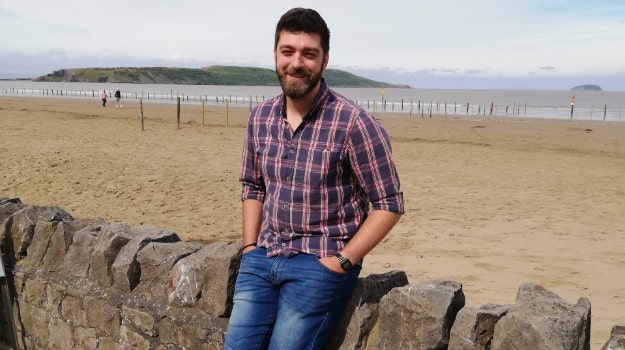
Andreas Papadopoulos joined Weston College in 2018, eight years after arriving in the UK from a recession-torn Greece with the equivalent of A-levels. He soon got a place at City of Bristol College, worked his way up from level 3 engineering to a level 5 foundation degree in aerospace engineering, and now lectures full-time at Weston College.
I’ve always had a passion for airplanes and how they work. I spent most of my childhood in Germany before my family returned to Greece and I took the equivalent of a BTEC level 3 in computing and IT studies. When recession hit, I moved to the UK in 2010 and felt my future lay in aerospace. I started from scratch at City of Bristol College’s aeronautics department, moving from a level 3 BTEC pathway to a level 5 in aeronautical engineering and then on to an aerospace degree course currently interrupted by my switch to teaching. My lecturer had suggested many of my key skills would equip me well to work in education - so I followed his advice! Aerospace jobs were scarce so I took a control engineering post within the UK railway industry while shadowing lecturers at Weston College in my spare time. I then became a part-time contract teacher of maths and IT at City of Bristol College before going full-time in aerospace engineering at Weston College.
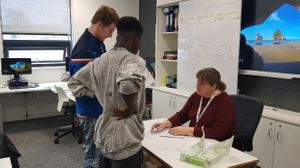
Teaching and assessing aerospace apprentices (aged 16-20+) from level 3 to level 5. The cohorts include many post-16 school-leavers, along with mature students who have switched courses or careers.
In their first year level 3 our apprentices study full-time to learn the skills, knowledge and behaviours relevant for the workplace. In the remaining three years leading up to a level 4 NVQ, they are in college one or two days a week. Many apprentices go on to a level 5 (foundation degree) that can then be topped up to a full degree. My work includes setting up resources within new frameworks, particularly in BTECs, writing assessment briefs and devising practicals. This is on top of recruiting, continuous enrolment, preparing and marking assignments, general assessment, and giving verbal feedback on skills, workplace behaviour and knowledge levels both to students and employers (eg Rolls Royce, GKN (formerly Bosch), Airbus and Ministry of Defence).
Given that health and safety and professional competences are a premium requirement in the aerospace industry, a key priority in the first year is setting standards by teaching students how to work effectively, to communicate and to behave professionally in the workshop; and these are often challenging concepts for 16-year-olds just out of school.
The subject is really popular - from just 12 students five years ago when the department was formed, we have now reached 600.
I start at 7.30am, prepare for the first session, remind myself what I need to cover and sort out resources to hand out. Normal teaching starts at 8am with tutorials and generally catching up with students, and then we’ll go through model questions we can do together. I have an online smart board and a smartpen and writeable tablet, and I use a program that copies everything over from the whiteboard so students don’t need to take notes. Classes range in size from 9-26 apprentices. Activities are used to link theory with practice include use of wind tunnels and model aeroplanes, thermal and fluid dynamics, destructive/undestructive tests on the qualities of different materials, mechanical principles and technical report writing, particularly in year 1.
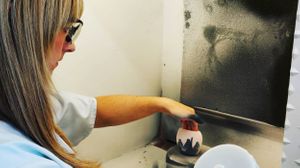
We often use the college wind tunnel to create and extrapolate data from testing forces acting on different wing profiles. (For the past three years we have run a wings week project, where apprentices are assessed as individuals and as a group completing a task involving building and test-flying a wing). We have also been calculating maximum payloads in varying circumstances by using a remote-controlled airplane and tested certain materials in a kiln to determine their thermal expansion properties.
Seeing first-year students transition from immature young adults to suddenly more professional and mature individuals. It is immensely rewarding to witness that lightbulb moment when they’ve understood a difficult concept, or watching them use tools they’d never even heard of just months before to produce a metal component or technical drawing on a computer screen.
Continually linking everything to industry. Getting views from students who are qualified or trainee pilots, or with other relevant skills. Keeping up to date with industry news - such as the latest on SpaceX, the new exploration company owned by Elon Musk.
Getting students to do more than their syllabus to ensure that they fully understand the underpinning skills, knowledge and behaviours for their endpoint assessment as they can over-focus on the assignments for the qualifications. I try to give them a good reason for the extra work so, for example, I asked them to practice writing technical reports - a few assignments later they were grateful when I showed them how much their reports had improved!
Winning the best lecturer award in my department within six months of joining; and getting thank you emails from my students.
Stay on top of the latest technology, whether it be new models, engines, aircraft manufacturing processes, regulation procedures, rule changes at airports, take-off distances or current topics. Be ready to foster and nurture your students -employment can be harsh and competitive so prepare them for the ups and downs. Be able to empathise and advise, particularly if apprentices are not offered a job by their employers at the end of their apprenticeship. Be ready with counter-arguments - they will invariably contradict you and yet they need to know you are only human and will make mistakes - if we don’t make mistakes, we won’t learn from them. And don’t be a robot! There is no repetition in education, so adapt your body language and behaviour to suit each individual.
A relevant science degree. I came into teaching with a level 5 (foundation degree) in Aeronautical engineering, was halfway through a top-up BSc degree (which I intend to finish later) and had spent six months teaching maths and IT part-time. When I started at Weston College, I was immediately asked to take a part-time Level 3 teaching qualification. Since I deliver FE and HE courses I am now also taking a Postgrad Certificate in Academic Practice (PCAP) in maths and education. I will soon complete a TAQA (Training, Assessment and Quality Assurance) assessor qualification needed to work with our apprentices.
Are you willing to go above and beyond for every student?
Seeing my students achieve - if they don’t you’ve not done something right.
AoCJobs, part of the Association of Colleges, connects teachers and support staff with schools and colleges for online job opportunities.